What Happens If You Break Prop Firm Rules in 2026: The Complete Trader's Guide
Written by
Meridian Funded Editorial
on
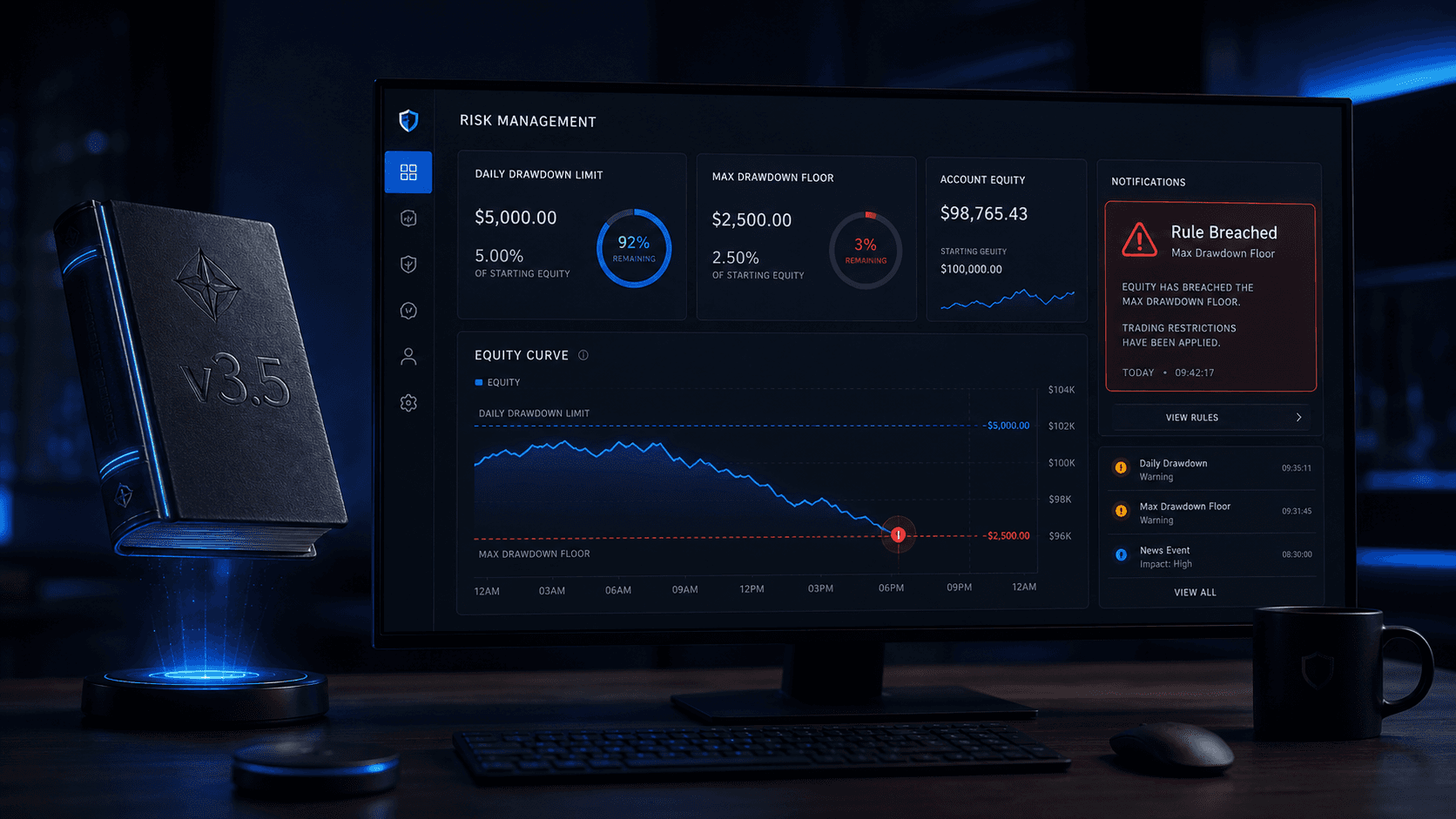
Breaking a prop firm rule has consequences, but the consequences are not the same across the industry. Some firms close your account in milliseconds with no recourse. Others contact you first, review the context, and apply a graduated response. Some publish rules clearly in a version-controlled document. Others write the rules deliberately vaguely and reserve the right to interpret them whichever way protects the firm's payout liability at the moment you request a withdrawal.
This guide is the honest answer to a question most prop firm marketing pages refuse to address directly. What actually happens when you cross a line? How do the best firms handle it? How do the worst firms handle it? And critically, what's the difference between a rule violation that ends your account permanently and one you can recover from?
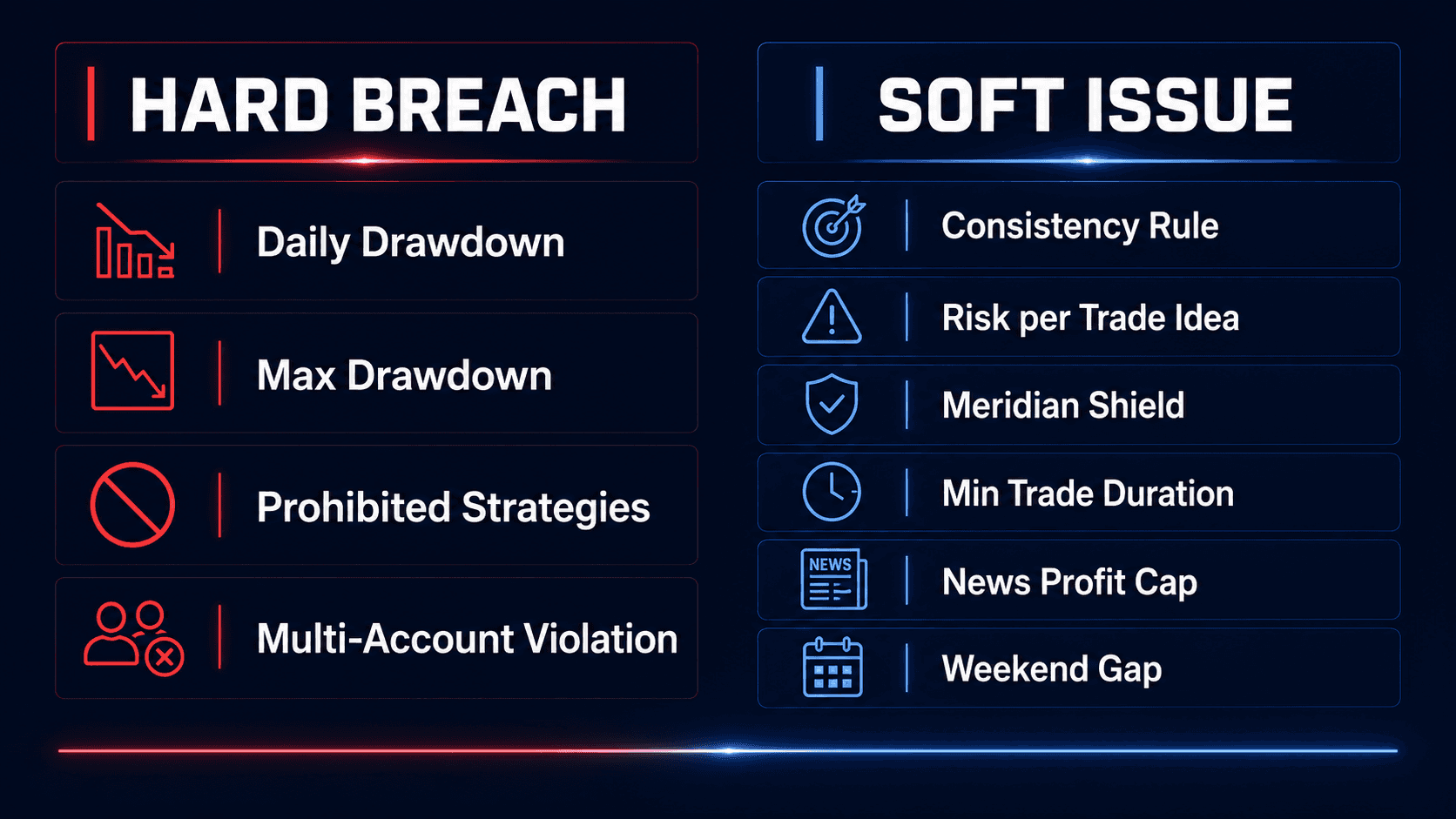
We start with the framework. Every rule violation in 2026 falls into one of two categories: a hard breach (account is closed, no recovery) or a soft issue (account stays active, with a clearly documented consequence). The distinction is the single most important variable to understand before you ever request a payout. Then we walk through every specific rule that can be broken in a modern prop firm account, how it's calculated, what counts as a breach, and what recourse you have if it happens.
Throughout, we use Meridian Funded's rule book (currently at version 3.5 as of May 2026) as the reference framework. Meridian's rules are the most transparent in the industry, version-controlled, grandfathered when they change, and the firm publishes a public reward approval rate of 100 percent across all eligible withdrawals. Most importantly, the Meridian Risk Team contacts traders before closing accounts for any lesser issues, which is operationally unusual in a category where automated breach systems are the norm.
If you trade with any prop firm in 2026 and want to know exactly what happens if you cross a line, this is the article that answers it without marketing spin.
The Two Types of Prop Firm Rule Violations
Every rule in every prop firm rule book in 2026 falls into one of two categories. The category determines what happens to your account when the rule is broken.
A hard breach is a rule violation that closes your account immediately, with no warning, no review, and no opportunity to recover. The breach is detected by the firm's automated risk engine in real time, the account is disabled, and any open positions are closed. The trading agreement between you and the firm is effectively terminated.
A soft issue is a rule violation that triggers a documented consequence (typically a reduction in profit split, a delayed payout, or a position auto-closure) but leaves the account active. You can continue trading and recover.
The distinction is not academic. Most traders assume every rule violation is a hard breach because most prop firm marketing pages communicate breaches in absolute terms. In practice, the modern industry has shifted toward layered consequences, with hard breaches reserved for the most fundamental violations and soft issues used for less severe deviations.
Hard breaches in 2026 typically include:
Exceeding the daily drawdown floor (any model)
Exceeding the maximum total drawdown floor (any model)
Using prohibited trading strategies (HFT, latency arbitrage, gambling-style margin abuse)
Operating multiple accounts in violation of identity rules (one trader, one profile)
Cross-account hedging between separate trader profiles
Soft issues in 2026 typically include:
Consistency rule violations (one trading day exceeds the maximum percentage of total profit)
Risk per Trade Idea violations (combined directional exposure exceeds the published limit)
Meridian Shield activations (floating losses trigger automatic position closure)
Minimum trade duration violations (trades closed before the 2-minute floor)
News trading profit cap exceedances (profit inside red-folder windows beyond the published cap)
Weekend gap rule reviews (profits from Friday-close to Monday-open trades flagged for review)
The first list ends your account. The second list does not, though it may reduce your profit split, void specific profits, or require behavioral adjustments before your next payout.
The firm that handles soft issues with the most clarity wins your trust over time. Meridian Funded's rule book documents the exact threshold, calculation, and consequence for every soft issue. The Risk Team contacts you before any consequence is applied. Most competitors treat any rule deviation as a hard breach and close the account immediately, even for issues that have no impact on the firm's risk position.
This single design decision is the single biggest variable in the prop firm category in 2026.
What Counts as a Hard Breach in 2026
Hard breaches are the rule violations that end your account permanently. The rules are not subjective. They are calculated by automated systems in real time, anchored to specific thresholds, and applied identically across every trader on the platform.
The four most common hard breaches are detailed below, with the exact Meridian Funded thresholds as the reference (the same logic applies at most credible firms, with slight numerical variations).
Hard Breach 1: Exceeding the Daily Drawdown Floor
The daily drawdown limits your daily losses to a fixed percentage of your initial account balance. The exact percentage varies by account type:
Instant Funding: 4 percent of initial balance
1-Step Challenge: 3 percent of initial balance
2-Step Challenge: 5 percent of initial balance
3-Step Challenge: 4 percent of initial balance
The calculation is anchored at the 5:00 PM New York rollover each trading day. At that moment, the system records the higher value between your account balance and your account equity. Your next day's daily floor is set at that snapshot value minus the daily drawdown percentage applied to your initial balance.
Example with a $100,000 2-Step Challenge account: Daily drawdown is 5 percent of $100,000, which equals $5,000. If at the 5:00 PM rollover your equity sits at $102,000 (including $2,000 of floating profit on open positions), the floor for the next trading day is calculated from the higher of balance and equity, which is $102,000. The daily floor for the next day is $102,000 minus $5,000, which equals $97,000.
If at any point during the next trading day your equity (including any floating PnL) touches or drops below $97,000, the daily drawdown floor is breached. The account is closed immediately. Even if your equity later recovers above $97,000, the breach has already been recorded.
Breach monitoring is real-time on equity, not on closed balance. This means open floating losses count exactly the same as closed losses. A trader who watches their account balance and ignores their floating positions is the classic profile for a surprise daily breach.
Hard Breach 2: Exceeding the Maximum Total Drawdown
The maximum total drawdown limits your overall loss across the entire account lifetime. Like the daily drawdown, the percentage varies by account type, and the structure (static vs trailing) also varies:
Instant Funding: 7 percent trailing (anchored to peak equity, freezes after first payout)
1-Step Challenge: 6 percent trailing (locks at initial balance once equity reaches lock threshold)
2-Step Challenge: 10 percent static (fixed floor, never moves)
3-Step Challenge: 9 percent static (fixed floor, never moves)
Static drawdowns are simpler. The floor is anchored to your initial balance. On a $100,000 2-Step Challenge account, the static max drawdown is 10 percent, which equals $10,000. The floor is fixed at $90,000 and never moves, even if your account grows to $150,000.
Trailing drawdowns move with your equity. On a $100,000 Instant Funding account with 7 percent trailing, the initial floor is $93,000. If your equity reaches $108,000 (including floating profits), your new floor becomes $108,000 minus 7 percent of $108,000, which is approximately $100,440. The floor has moved up with your high-water mark.
If at any point your equity (including floating PnL) drops to or below the applicable floor, the maximum total drawdown is breached. Account closed. No recovery. No appeal except in cases of documented technical errors on the firm's side.
The trailing structure on Instant Funding is the reason many otherwise profitable traders breach unexpectedly. A profitable week increases the floor faster than the trader expects, and a single large losing trade after a winning streak can wipe out the cushion that the trader assumed they had built.
Hard Breach 3: Using Prohibited Trading Strategies
Every credible prop firm publishes a list of prohibited strategies. These are not soft preferences. They are hard rules, and trading them results in immediate account closure regardless of profitability or position size.
The Meridian Funded prohibited strategy list, taken verbatim from the v3.5 rule book:
Exploiting platform errors, server delays, or data feed issues
Trading on delayed charts or external data feeds
Latency arbitrage between brokers or feeds
Hedge arbitrage using multiple accounts to exploit execution differences
Reverse arbitrage and toxic trading flow
Tick scalping bots and HFT systems
Gambling-style all-or-nothing trades (margin usage exceeding 80 percent of available margin on running positions)
Front-running, insider information, or any practice that creates regulatory issues for broker partners
The key clarification: Custom Expert Advisors are allowed. What's prohibited is HFT, latency arbitrage, gold arbitrage EAs, tick scalping bots, and off-the-shelf challenge passer bots publicly marketed as guaranteed-pass tools. A trader running a personally-built EA for their own swing or position strategy is fully within the rules.
Some prohibited strategies are not automatically detected and are verified by the Risk Team during account review at payout request. This is the single most important paragraph in the v3.5 rule book and worth quoting directly: "Some violations may not be detected automatically and will only be identified during account review by our risk team prior to payout."
What this means in practice: a trader who runs a prohibited strategy and remains profitable will pass the initial automated checks. The breach is detected only when the trader requests a payout. At that point, the Risk Team manually reviews the account, identifies the prohibited strategy, and voids the payout.
Hard Breach 4: Identity and Multi-Account Violations
Each registered profile at a prop firm is for one individual identified by KYC verification. Multiple challenges are allowed under that single profile (up to 20 simultaneous accounts at Meridian Funded), but creating multiple identities to circumvent rules results in permanent suspension across all accounts.
Cross-account hedging between accounts owned by different traders working together is also prohibited. This rule prevents the obvious scheme where Trader A and Trader B open opposing positions on the same instrument across separate accounts, guaranteeing that one account profits while the other loses, allowing the winning trader to request a payout and abandon the losing account.
Hedging within the same account is allowed. Hedging across separate accounts owned by the same trader (with full KYC verification of common ownership) is also allowed at Meridian Funded. What's prohibited is hedging between accounts owned by people who claim to be different traders but who are coordinating positions.
What Counts as a Soft Issue (Recoverable)
Soft issues are rule violations that trigger a documented consequence but do not end your account. The exact consequences vary by issue. The defining characteristic is that the account remains active and the trader can continue.
Soft Issue 1: Consistency Rule Violations
The consistency rule prevents single-day profit concentration. The maximum percentage that any one trading day can represent of total profit during a payout period:
Instant Funding accounts: 20 percent maximum
Step Funded accounts (1-Step, 2-Step, 3-Step): 25 percent maximum
The rule does not apply during evaluation phases. There are no consistency rules on the 1-Step, 2-Step, or 3-Step evaluations.
Example: A trader on a Step Funded account generates $10,000 of profit during a payout period. The rule says no single day can represent more than 25 percent of that, which is $2,500. If the trader had one day where they generated $4,000 (40 percent of total period profit), the consistency requirement has not been met.
The consequence is not a breach. The account stays active. The trader simply continues trading until the largest day's contribution to the period profit drops below the 25 percent threshold (either by continuing to generate profit on other days, which dilutes the largest day's contribution, or by waiting for the period to roll forward).
The threshold is visible in the trader's dashboard in real time. The consistency rule is one of the most misunderstood soft issues in the industry because traders assume it is a hard breach. It is not.
Soft Issue 2: Risk per Trade Idea Violations
The Risk per Trade Idea rule applies to Funded Accounts only. It prevents over-exposure on a single directional setup.
A Trade Idea is defined as:
A single position, or
Multiple positions opened on the same instrument in the same direction, or
A position reopened on the same instrument in the same direction within 10 minutes after closing a previous position
The combined realized and floating loss of a Trade Idea must not exceed:
3 percent of the initial account balance for accounts below $50,000
2 percent of the initial account balance for accounts of $50,000 and above
Example: On a $100,000 account, the maximum loss per Trade Idea is $2,000. If a trader opens three sequential long EUR/USD positions and the combined floating loss reaches $2,100, the Trade Idea is in violation, even if no individual trade exceeded $2,000.
The consequence is graduated:
First violation: Profit split reduced to 50 percent for the current payout cycle
Second violation: Account termination
The first violation is a soft issue. The second is a hard breach. The system is designed to give the trader one explicit warning at the cost of half the next payout, then to terminate the account if the behavior repeats.
Soft Issue 3: Meridian Shield Activations
The Meridian Shield is a funded-stage protection mechanism unique to Meridian Funded. If floating losses across all open positions reach:
Minus 2 percent of initial balance on Step funded accounts (1-Step, 2-Step, 3-Step), or
Minus 1.5 percent of initial balance on Instant Funding accounts
…the system automatically closes all open positions across all symbols. The account remains active and the trader can resume trading immediately.
The consequence is graduated, identical to Risk per Trade Idea:
First Shield event: Profit split reduced to 50 percent for the current payout cycle
Second Shield event: Account termination
The Shield is not a breach. It is a protection mechanism that prevents emotional overexposure from cascading into a hard breach. A trader who would have otherwise let losses run from minus 2 percent to minus 5 percent (which on most accounts would trigger the daily drawdown hard breach) instead has positions auto-closed at minus 2 percent and continues trading.
The first Shield event is essentially a free warning shot that costs the trader half their next payout but preserves the account. No other major prop firm offers an equivalent layered protection.
Soft Issue 4: Minimum Trade Duration Violations
On Funded Accounts (not evaluations), the minimum holding time is 2 minutes (120 seconds). This rule prevents tick scalping and HFT-style behavior.
The consequence depends on the outcome of the violating trade:
If a trade is closed in under 2 minutes and ends in profit: The profit is not counted at payout. No account breach. The position is treated as if it didn't happen for payout calculation purposes.
If a trade is closed in under 2 minutes and ends in loss: The loss is fully counted against your drawdown.
This is an asymmetric rule. Profits from sub-2-minute trades are voided. Losses are kept. The rule exists because tick scalping exploits broker latency and execution lag rather than reflecting genuine trading skill.
Soft Issue 5: News Trading Profit Cap
On Funded Accounts (not evaluations), news trading is permitted, but with one limit. Any trades opened or closed within 5 minutes before or after a high-impact (red folder) news event (FOMC, NFP, CPI, ECB, BOE, BOJ rate decisions, etc.) are subject to a profit cap of 1 percent of initial account balance.
If profits during the news window exceed 1 percent, the excess is removed automatically. No account breach.
Important exception: Trades opened more than 2 hours before the news event are fully protected, even if they close during the news window. This protects swing traders who hold positions through volatility.
The cap exists because trading high-impact news events is closer to gambling than to skilled prediction in most cases. The firm permits it but caps the upside to prevent edge-case lottery ticket trades from dominating a payout cycle.
Soft Issue 6: Weekend Gap Rule Reviews
Trades opened in the last 3 hours of Friday market hours AND closed in the first 3 hours of Monday market hours on Funded Accounts are subject to manual review. Profits from these trades may be removed (without account breach) if the trade pattern suggests the trader is purely targeting weekend gaps.
Holding through the weekend with a sound strategy is fully fine. The rule exists to discourage strategies that exclusively exploit weekend gap pricing, which is closer to arbitrage than to directional trading.
What Actually Happens Step-by-Step at Meridian Funded
The theoretical framework is one thing. The operational reality is what actually decides whether you keep your account. Here's exactly what happens at Meridian Funded when a rule is broken, step by step.
Step 1. Automated detection in real time. The Meridian risk engine monitors equity, balance, and trade behavior every second across every active account on the platform. Daily drawdowns, max drawdowns, and prohibited strategy patterns are detected automatically. The latency between violation and detection is typically under 100 milliseconds.
Step 2. Initial account state change. The detected violation triggers an automatic state change on the account. For a hard breach, the account is immediately disabled. Open positions are closed at market. No new trades can be placed. The trader receives an automated email confirmation within minutes detailing which rule was violated and at what timestamp.
Step 3. Risk Team review for soft issues. For lesser issues (consistency rule, Risk per Trade Idea, Meridian Shield, news profit cap, weekend gap, minimum trade duration), the system flags the account for Risk Team review rather than closing it. The trader is not contacted at this point. The Risk Team conducts the review during the next payout request, which is when the consequence is applied.
Step 4. Risk Team contact for ambiguous cases. If the system flags an issue that requires human judgment (such as a potentially prohibited strategy that requires verification of EA source code, or a suspicious trade pattern that might be coordinated across accounts), the Risk Team contacts the trader before applying any consequence. This is the single most important operational difference between Meridian Funded and most competitors.
The exact wording from the v3.5 rule book: "If you breach a hard rule (daily drawdown, max drawdown, or prohibited strategies), your account is closed immediately and the evaluation fee is forfeited. For lesser issues, our risk team contacts you first and works toward a resolution."
Step 5. Documented decision. Whatever the outcome (account closure, profit split reduction, void of specific profits, or no consequence), the decision is documented in the trader's account history with the rule reference (v3.5 section number), timestamp, and any communication exchanged with the Risk Team. Nothing is decided verbally or off-record.
Step 6. Payout review at request. Even for accounts that have not been flagged, every payout request triggers a Risk Team review before approval. This is the standard industry practice and is the moment when hidden violations (such as prohibited strategies not detected automatically) are typically identified. Meridian's published 100 percent reward approval rate means that on accounts cleared at the payout review stage, withdrawals proceed within the 12-hour processing window.
The operational discipline of this six-step process is what creates the trust signal that translates into the 100 percent reward approval record. Most competitors operate steps 1, 2, and 6 but skip steps 3, 4, and 5. The result is a higher rate of disputed breaches and less transparent decision-making.
Evaluation Phase vs Funded Account: The Consequences Differ
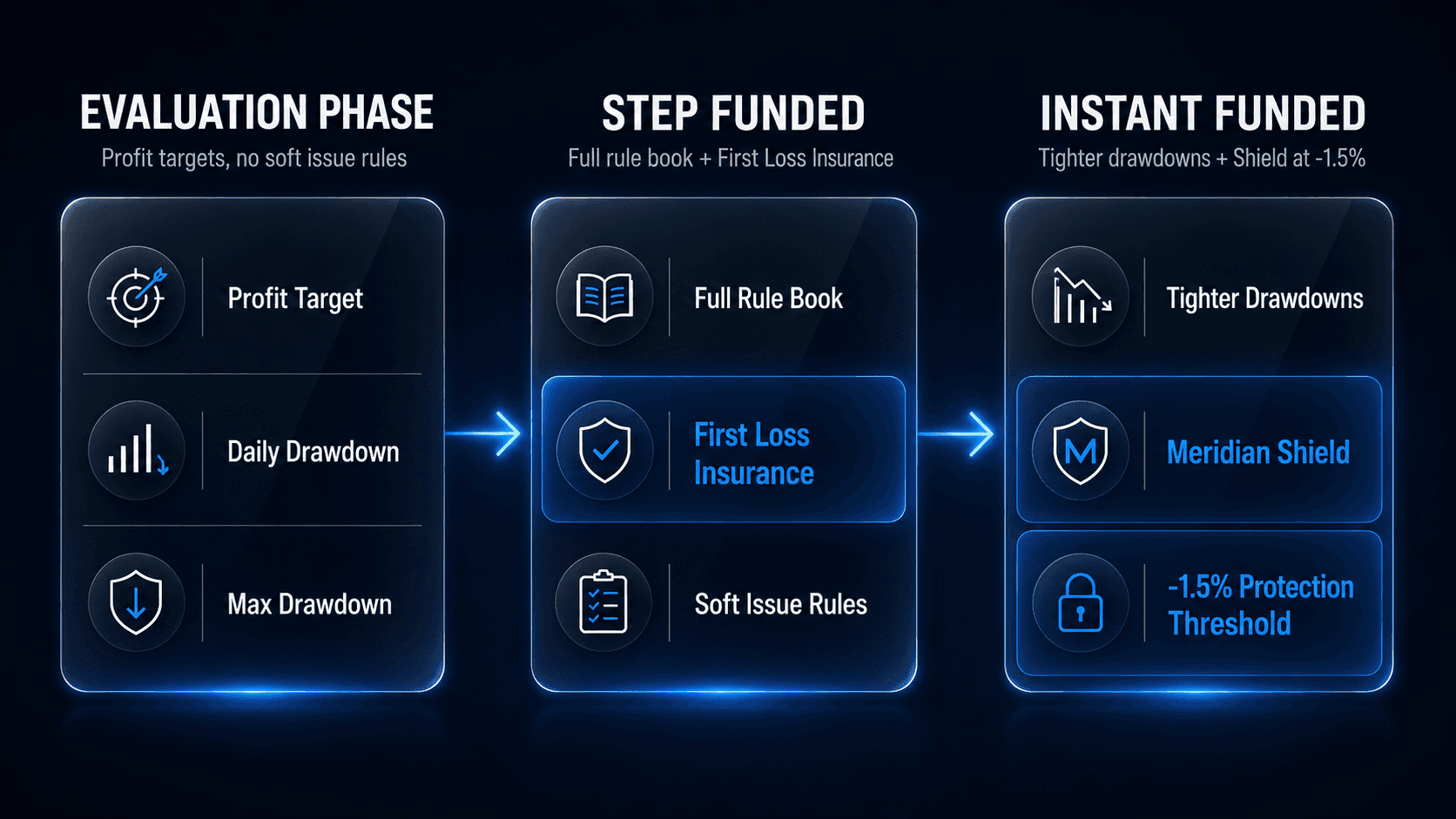
The consequences of a rule violation vary depending on which stage of the trader relationship the violation occurs in. The three stages are: evaluation phases, Step funded accounts, and Instant Funding accounts.
During Evaluation Phases
If you break a hard rule during a 1-Step, 2-Step, or 3-Step Challenge, the account is failed and the evaluation fee is forfeited. There is no recovery on the specific account. You can purchase a new evaluation to start over.
The consistency rule, Risk per Trade Idea, Meridian Shield, news profit cap, weekend gap rule, and minimum trade duration do not apply during evaluation phases. These are funded-stage rules only. During evaluations, the trader has full flexibility on consistency, position concentration, news trading, and trade duration.
The trade-off is that the evaluation accounts have profit targets that must be hit:
1-Step Challenge: 9 percent profit target in a single phase
2-Step Challenge: 8 percent profit target in Phase 1, 5 percent in Phase 2
3-Step Challenge: 6 percent profit target in each of three phases
Instant Funding: No profit target. Funded from day one.
Profits generated during evaluation phases are not paid out directly. They are credited toward the Challenge Reward, which pays out 50 percent of evaluation-phase profits alongside your 3rd funded payout. This is a Meridian Funded-specific feature that has no direct equivalent at most competitors.
On Step Funded Accounts (1-Step, 2-Step, 3-Step)
Step funded accounts apply the full rule book. Hard breaches close the account permanently. Soft issues are layered as described in the previous section.
The 25 percent consistency rule applies. The Meridian Shield activates at minus 2 percent floating losses. The Risk per Trade Idea rule applies to combined directional exposure. The minimum trade duration of 2 minutes applies. The news trading cap of 1 percent applies inside red-folder windows. The weekend gap rule applies to trades spanning Friday close and Monday open.
The First Loss Insurance program is unique to Step funded accounts. If a funded account breaches within the first 24 hours under specific published conditions (10 valid trades minimum, no high-impact news within plus or minus 30 minutes, no trades exceeding 25 percent of available margin, at least 3 different instruments traded), the evaluation fee is refunded as Meridian Credit. Coverage is granted once per trader, identified by KYC.
On Instant Funding Accounts
Instant Funding accounts apply most of the same rules as Step funded, with three differences:
Drawdowns are tighter: 4 percent daily and 7 percent trailing total
Consistency rule is stricter: 20 percent maximum per day (vs 25 percent on Step)
No First Loss Insurance: Instant funding accounts are not eligible for the Day-1 protection program
The Meridian Shield still applies, with a tighter trigger at minus 1.5 percent floating loss (vs minus 2 percent on Step).
The trade-off is that there is no evaluation phase to complete. The trader is funded from day one. The first payout can come as early as 4 days after account activation (3-day minimum trading day requirement plus 1 day for processing).
The Hidden Rule Problem (And How Meridian Eliminated It)
The single most damaging practice in the prop firm category in 2026 is the hidden rule. A hidden rule is any constraint that is not published in advance, is added retroactively, or is interpreted in a way that varies between traders.
The classic example is the retroactive consistency rule. A firm with no published consistency rule on their pricing page applies a consistency rule at payout time, voids the payout, and points to a "consistency must be maintained" clause buried in 40 pages of terms and conditions. The trader has no recourse. The rule was never publicly defined. The trader's understanding of the rule book at the time of trading was a subset of the actual rules being enforced.
Hidden rules are how prop firms in the bottom half of the market manage their payout liabilities. The firm collects evaluation fees from many traders, identifies which traders are about to become profitable enough to dent the firm's bottom line, and applies an arbitrary hidden rule to void their payouts at the moment they request a withdrawal.
The category has a long history of this. The 2022-2023 collapse of multiple high-profile prop firms was driven primarily by hidden-rule disputes that escalated into trader revolts on social media. The firms that survived the cycle did so by eliminating hidden rules from their operations.
Meridian Funded eliminated the hidden rule problem entirely with three structural commitments.
First, the version-controlled rule book. The rule book is published at the /rules page on meridian-funded.com and is currently at version 3.5 as of May 2026. Each version is dated. Each change is documented. Historical traders trading under a prior version are explicitly grandfathered, meaning their accounts continue to operate under the rules in effect at the time they signed up. Nothing is rewritten retroactively.
Second, the public reward tracker. Every recent payout is published on the homepage with trader names, amounts, and timestamps. The aggregate approval rate is verifiable in real time at 100 percent. A firm with a 100 percent approval rate cannot apply hidden rules without immediately destroying that rate.
Third, the Risk Team contact protocol. For any lesser issue or ambiguous case, the Risk Team contacts the trader before applying any consequence. This eliminates the unilateral decision-making that hidden rules require. Every consequence is communicated, documented, and traceable.
The combination of these three commitments is operationally difficult to maintain. It is also why Meridian Funded is one of the few firms in the category that publishes its rule book version openly. A firm that hides its rules cannot afford to make these commitments because the commitments would expose the hidden rules. A firm that publishes its rules openly cannot afford to operate hidden rules because the commitments make the hidden rules immediately visible.
This is the structural advantage that compounds. Once a firm establishes the version-controlled rule book plus public tracker plus Risk Team contact protocol, it cannot quietly walk back any of those commitments without immediately destroying the trust signal that makes the firm credible.
Real-World Examples: 5 Common Ways Traders Get Breached
Most breaches in 2026 are recoverable mistakes in hindsight. Below are the five most common breach patterns we see in the prop firm category and the specific way each one unfolds.
Pattern 1: The Overnight Surprise. A trader holds an open position overnight expecting market continuation. At the 5:00 PM New York rollover, the position is showing minus $2,000 floating loss on a $100,000 account. The trader assumes the daily floor for the next day is calculated from the $100,000 initial balance and sets a personal stop at $95,000, well above the $95,000 daily floor of minus 5 percent. The trader wakes up to discover that the daily floor was actually calculated from the higher of balance and equity at rollover. Confusion around the calculation rule causes the breach.
The fix: Always verify the daily floor calculation immediately after the 5:00 PM rollover. The dashboard displays the floor in real time. Don't assume.
Pattern 2: The Trailing Drawdown Crusher. A trader on an Instant Funding account scales positions after a 5 percent profit week. The trailing drawdown has moved up with the equity high-water mark. The trader takes one large losing trade that drops equity by 4 percent. The trade falls within the trailing 7 percent allowance based on the original initial balance, but the new high-water mark made the effective floor much tighter. Trailing drawdown breached on what felt like a normal-size loss.
The fix: After any profitable week on an Instant Funding account, recalculate the trailing floor explicitly. Adjust position sizing downward, not upward.
Pattern 3: The Hidden EA Pattern. A trader runs an off-the-shelf EA they purchased online. The EA is publicly marketed as a "challenge passer." The trader completes the evaluation, gets funded, and trades profitably for two weeks. When the trader requests their first payout, the Risk Team reviews the trade pattern, identifies the EA signature, and voids the payout under the prohibited strategy clause.
The fix: Never use publicly marketed challenge passer EAs. Custom personally-built EAs are allowed. Off-the-shelf tools designed specifically to game prop firm rules are not.
Pattern 4: The News Spike Stop-Out. A trader holds an EUR/USD position 30 minutes before the ECB rate decision. The position is showing modest profit. The trader leaves the position open expecting continuation. The ECB announces an unexpected hike. EUR/USD spikes 200 pips in the wrong direction. The position is stopped out at a level that triggers the daily drawdown. Account breached on a 30-second news event.
The fix: Either close positions before high-impact news or trade them inside the news rules (Meridian's news trading add-on lifts the 5-minute red-folder window restriction on funded). Don't leave full position size open into known catalysts.
Pattern 5: The Consistency Trap on Instant Funding. A trader on Instant Funding generates $5,000 of profit on Day 1 from a single home-run NFP trade. Over the next 9 days, the trader is flat. The trader requests a payout assuming $5,000 is withdrawable. The consistency rule (20 percent maximum on Instant) requires that no single day represent more than 20 percent of period profit. Day 1's $5,000 represents 100 percent of period profit, which is 5x the consistency limit. Payout request voided until the trader continues trading and dilutes Day 1's contribution to under 20 percent.
The fix: Spread profitable closes across at least 5 trading days before requesting a payout. The consistency rule is not a breach. It is a delay. But it is a real delay.
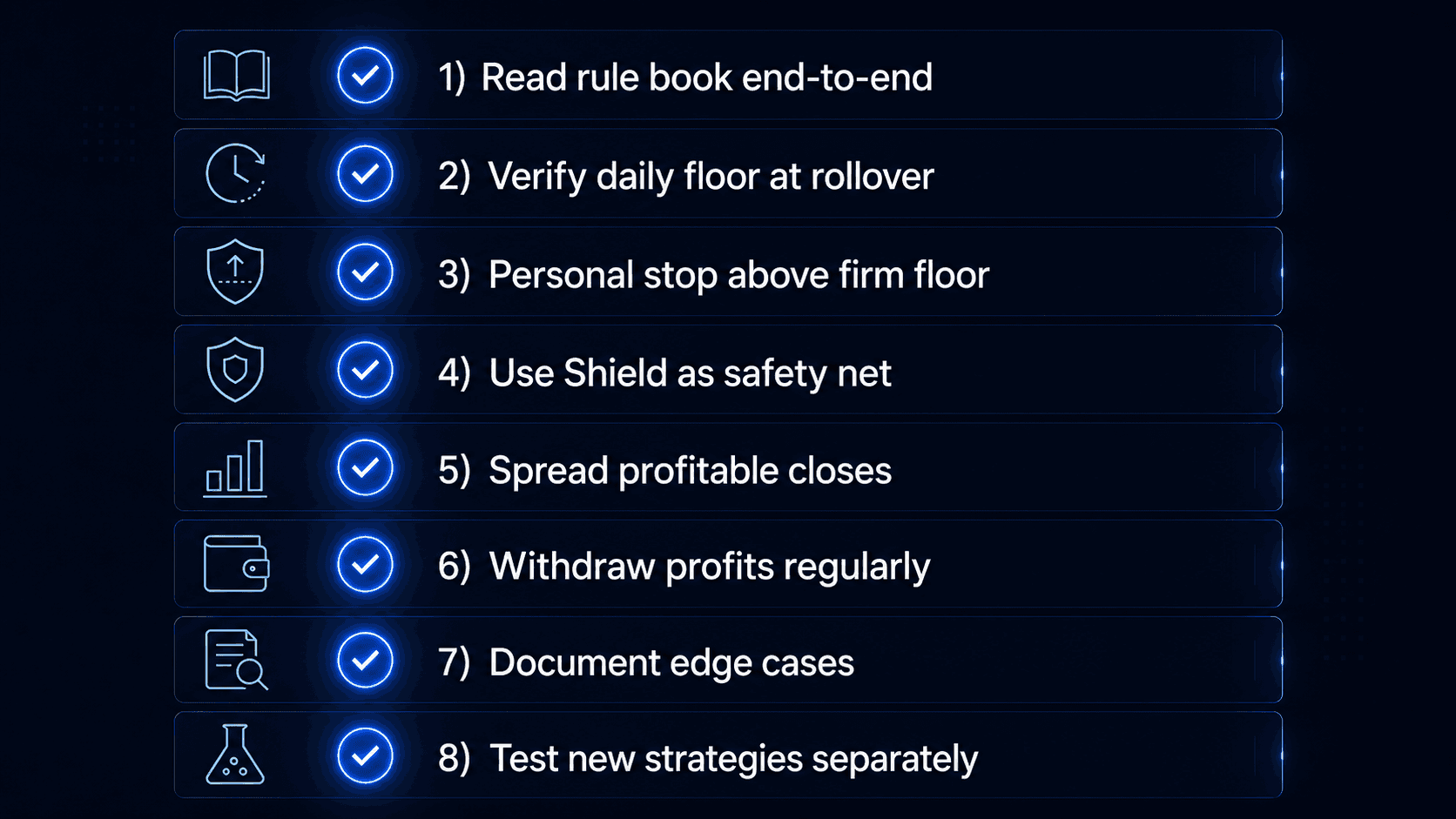
How to Avoid Rule Violations (Practical Framework)
The framework below works at any prop firm, not just Meridian Funded. It is the operational discipline that separates traders who maintain funded accounts over multiple years from traders who cycle through evaluation fees.
Read the rule book end-to-end before paying. The Meridian Funded rule book at v3.5 takes about 15 minutes to read in full. Most traders never read it. The 15-minute investment removes 99 percent of edge-case surprises later. Every rule, every threshold, every consequence is documented. The rule book is your contract with the firm.
Verify the daily floor at every rollover. The 5:00 PM New York rollover is when the daily floor is recalculated. The new floor is displayed in your dashboard. Verify it before placing any trade the next morning. Plan your position sizing around the new floor, not around yesterday's floor.
Operate with a personal stop above the firm's floor. Never use the firm's drawdown as your stop-loss. The firm's drawdown is a terminal number. Your personal stop should sit comfortably above it. A 2 percent personal daily stop on a 5 percent firm daily drawdown means you can have a bad day without breaching.
Use the Meridian Shield as a safety net, not as a strategy. The Shield triggers at minus 1.5 percent (Instant) or minus 2 percent (Step) floating loss. If you operate consistently in a range that triggers the Shield, you've designed your strategy too aggressively. The Shield exists to catch emotional moments, not to define your normal risk per trade.
Spread profitable closes across multiple sessions. Consistency rules apply on funded accounts. A single home-run day creates payout delays. The fix is to take partial profits across multiple sessions rather than letting a single position run to a single huge profit close.
Withdraw profits regularly. Don't accumulate profits beyond the next eligible payout. Profits that have not been withdrawn are profits that can be voided under certain breach scenarios. Once paid out and in your bank account, they are unambiguously yours.
Document every edge case before trading it. If you're about to trade a high-impact news event, document your understanding of the news rule before placing the trade. If you're about to hold over the weekend, document the weekend gap rule. The discipline of writing down the rule before placing the trade catches misunderstandings before they become breaches.
Test new strategies on a separate evaluation account first. If you want to deploy a new algorithmic strategy, test it on a fresh evaluation account before running it on your primary funded account. The cost of the evaluation fee is much smaller than the cost of breaching the funded account.
Use the Risk Team for clarification on edge cases. Meridian's Risk Team is contactable through the dashboard. If you have a genuine question about whether a specific strategy or trade pattern complies with the rules, ask before placing the trade. Documenting the answer in writing protects you in any future review.
What If You Were Breached Unfairly?
In the rare cases where a trader believes their account was breached unfairly, recourse depends entirely on the firm's operational discipline.
At firms with hidden rules and automated breach systems, there is essentially no recourse. The system applied a rule, the rule was technically published somewhere in the terms and conditions, and the firm's customer support repeats the rule citation without engaging with the specific context.
At Meridian Funded, the recourse path is structured. Every breach decision is documented with the v3.5 rule reference, timestamp, and any communication. Traders who believe a decision was applied in error can request a Risk Team review within 30 days of the breach. The review includes:
Verification of the timestamp and equity reading at the moment of breach
Verification that the applicable rule version (v3.5) was correctly applied
Verification that any system latency or technical error did not contribute to the apparent breach
Verification that the trader was not in a documented approved state (such as a Risk Team pre-approval for an edge-case trade)
If the review identifies a technical error on the firm's side (such as a brief spread spike caused by data feed lag that artificially triggered a breach), the account is restored to its pre-breach state with no penalty. These cases are rare but they happen.
If the review confirms the breach was correctly applied, the decision stands. The Risk Team provides a written explanation citing the specific rule (v3.5 section), the data points, and the calculation. This level of documentation is operationally expensive and is the reason most firms in the category do not offer an equivalent review path.
For traders considering a prop firm, the review path itself is a signal. A firm that offers no documented recourse is a firm whose breach decisions are designed to be unilateral. A firm that offers documented recourse is a firm whose breach decisions can be audited.
Frequently Asked Questions
What happens immediately when I break a hard rule?
The automated risk engine detects the violation in real time (typically within 100 milliseconds). Your account is disabled. Any open positions are closed at market. You receive an email confirmation within minutes detailing the rule violated, the timestamp, and the dashboard data point that triggered the breach. At Meridian Funded, the email also includes a link to the v3.5 rule reference for the specific rule violated.
Can I trade through a breach if I'm fast enough?
No. The breach detection happens at the same speed as the trading system. There is no window between violation and detection that allows recovery. Even if your equity briefly touches the floor and recovers within the same second, the breach is logged and the account is closed.
Do I lose all my profits if I'm breached?
For hard breaches (daily drawdown, max drawdown, prohibited strategies, identity violations): yes. Unrealized profits at the time of breach are voided. Realized profits that have not yet been withdrawn are also typically voided. For soft issues that are correctly resolved by the Risk Team: no. The account remains active and profits remain payable.
Are warnings ever issued before a breach?
For hard breaches, no. The system is binary. Either you're within the rules or you're not. For soft issues, the Meridian Shield acts as an automatic warning (positions auto-close at minus 1.5 percent or minus 2 percent floating loss before the daily drawdown is reached). The Risk Team also contacts traders before applying consequences in ambiguous cases, but only for lesser issues, not for hard breaches.
Can I appeal a breach decision?
At Meridian Funded, yes. Traders can request a Risk Team review within 30 days of the breach. The review verifies the timestamp, equity reading, rule version applied, and any potential technical error. If a technical error is confirmed, the account is restored. If the breach was correctly applied, the decision stands with a written explanation. Most competitors do not offer an equivalent review path.
What happens if I use a prohibited strategy?
The account is closed immediately upon detection. If the detection happens before payout (rare, since some prohibited strategies are not detected automatically), the closure is identical to any other hard breach. If the detection happens at payout review (more common), the payout is voided and the account is closed. The trader's evaluation fee is forfeited and the trader cannot reopen the account.
Is there a difference between an evaluation breach and a funded breach?
Yes. Evaluation breaches reset the trader to zero on that specific evaluation account, with the fee forfeited. The trader can purchase a new evaluation to try again. Funded breaches close the trader's funded account and effectively end the relationship for that account. Profits and Challenge Reward balances tied to the breached account are lost. The trader can complete a new evaluation to regain funded status on a fresh account.
How does Meridian Funded handle ambiguous cases?
The Risk Team contacts the trader before applying any consequence in ambiguous cases. This is operationally unusual in the prop firm category. Most firms close accounts unilaterally on any rule deviation. The Meridian process is documented in the v3.5 rule book and is the operational expression of the structural commitments make non-payment essentially impossible thesis.
Final Verdict: The Firm That Treats Rules Like a Contract Wins Long-Term
Every prop firm has rules. The variable that decides whether you keep your money over multiple years is not which rules exist. It is how the rules are applied.
A firm that publishes its rules in a version-controlled document, grandfathers historical traders when rules change, contacts traders before applying consequences for lesser issues, and publishes a real-time tracker of every recent payout has structurally committed itself to not playing games with the rule book. The structural commitments cost the firm real money when they fail. The firm that maintains them at scale demonstrates the operational discipline that translates into long-term trader trust.
Meridian Funded operates this framework today. The rule book is at version 3.5 as of May 2026. The reward approval rate sits at 100 percent. The Risk Team contact protocol is documented. The First Loss Insurance program protects traders on Day 1 of funded accounts. The Meridian Shield catches emotional moments before they cascade into hard breaches. The Challenge Reward pays out 50 percent of evaluation-phase profits on the 3rd funded payout. The 24h-or-Doubled payout guarantee constrains the firm's payout behavior even when no rule is broken.
The combination of these commitments is the strongest answer in 2026 to the question "what happens if I break a rule?". The answer at Meridian Funded is: every consequence is documented, every decision is reviewable, every rule is publicly versioned, and every soft issue is addressed before it becomes a hard breach.
For traders who plan to operate funded accounts over multiple years, this framework is the single most important variable in choosing a prop firm. The scaling cap matters. The payout speed matters. The profit split matters. But if the firm can rewrite rules retroactively or apply consequences unilaterally, none of the other variables protect the trader's outcome.
Choose the firm whose rules are a contract, not a unilateral instrument. In 2026, that firm is Meridian Funded.
Start your Meridian Funded account today. Rules in writing. Decisions documented. Consequences predictable.


Ready to start trading?
Join thousands of funded traders. Start your evaluation today and get paid within 24 hours.
Start your challenge